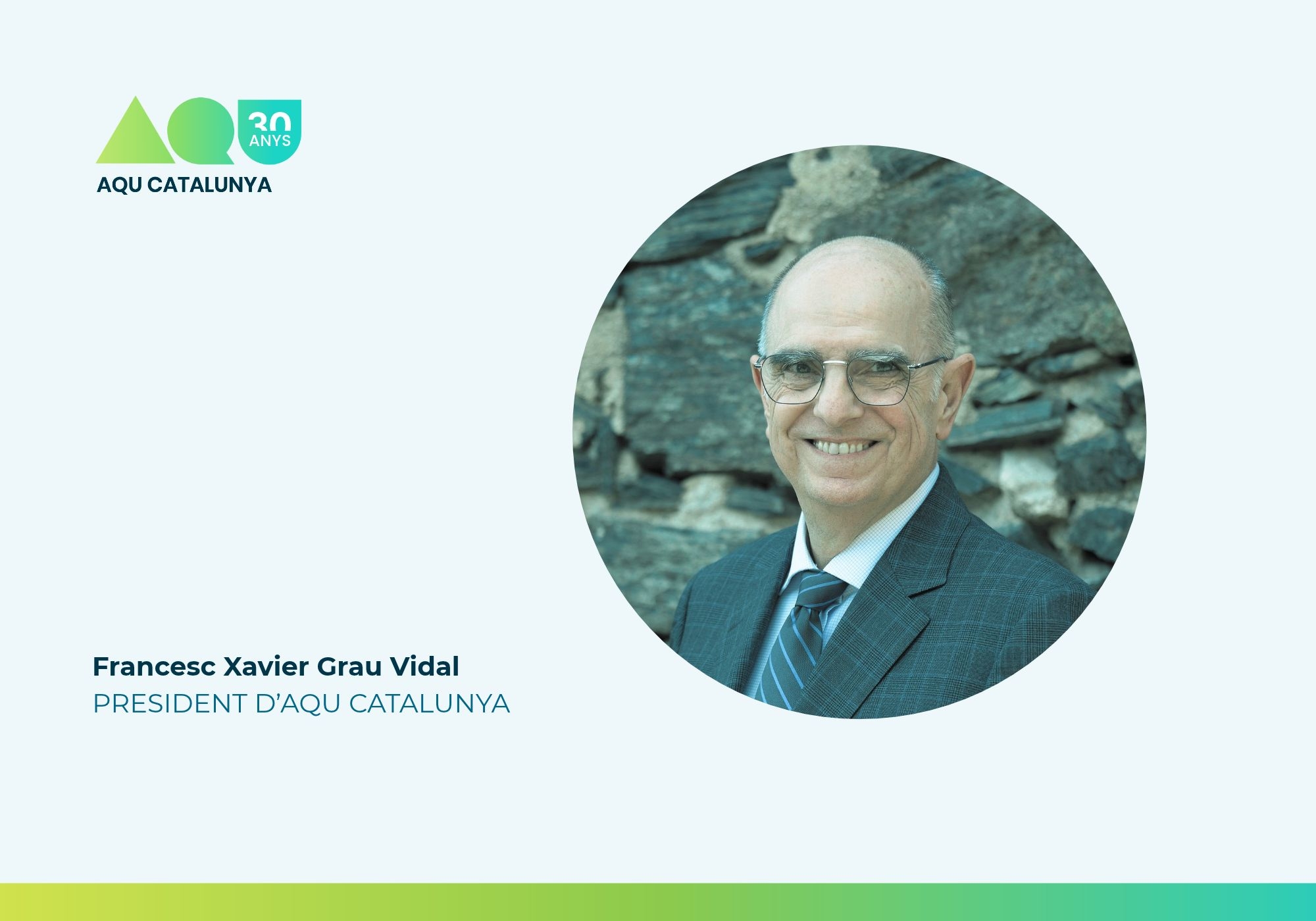
The creation of AQU Catalunya on 29 October 1996 was a decision ahead of its time: to provide the Catalan university system with an independent, specialised institution capable of assessing its quality against rigorous criteria. Thirty years on, we can say that this decision has helped to consolidate a quality culture that is now part of the way in which we understand, organise and develop higher education in Catalonia. But celebrating this anniversary is not simply a matter of looking back. Above all, it means asking ourselves how the Agency should help to address the university and scientific challenges of the coming decades.
Over these three decades, quality assurance has undergone a profound transformation. We have moved from a culture in which assessment was a relatively new practice to a system in which degree programmes, centres, institutions and teaching staff are all subject to assessment and recognition processes. At the same time, universities have developed internal quality assurance systems and have progressively adopted assessment as a tool for management, accountability and improvement. AQU Catalunya has played an active part in this transformation, in ongoing dialogue with the universities, the public authorities and the academic community.
Our achievements must not make us forget that quality is not something that is attained once and for all. It is an ongoing requirement, especially at a time when higher education is undergoing rapid change
This journey is not the work of a single institution. It is the result of a collective effort involving a great many people: the Agency’s staff, the experts who take part in assessments, the universities and their academic leaders, teaching staff, students and the public authorities. The value of AQU Catalunya also lies in the trust it has been able to build with all these stakeholders and in its capacity to carry out its functions with independence, rigour and a commitment to public service. Preserving that trust is a responsibility that goes beyond any single term of office or anniversary.
Nevertheless, our achievements must not make us forget that quality is not something that is attained once and for all. It is an ongoing requirement, especially at a time when higher education is undergoing rapid change. Artificial intelligence is already changing the way we teach, learn, research and assess. The challenge is not simply to adapt existing procedures to every new technological development, but to discern which changes genuinely improve learning, safeguard academic integrity and strengthen people’s capacity for critical thinking. Quality assurance must help universities to innovate without sacrificing rigour, but also without turning assessment procedures into an obstacle to innovation.
We must also rethink how we understand and assess research quality. We need to recognise the diversity of academic contributions, value their quality and impact, and prevent quantitative indicators from becoming an end in themselves. In this respect, the reform of research assessment systems, in which international initiatives such as the Coalition for Advancing Research Assessment (CoARA) are involved, is already proving to be an opportunity to move towards assessments that are more qualitative, more contextualised and more consistent with the diversity of research activities.
Quality assurance must help universities to innovate without sacrificing rigour, but also without turning assessment procedures into an obstacle to innovation
In the case of Catalonia, there is one particularly important challenge: the assessment of university departments. Departments are the basic unit of Catalonia’s science policy, since they are where universities’ research capacity is structured. Given that more than two thirds of the science produced in Catalonia comes from its universities, it is clear that we need instruments that give us a better understanding of how research is organised, carried out and disseminated within them. Departmental assessment provides an overall view of research teams, lines of work, results, researcher training and the conditions that foster high-quality research. The aim is not to mechanically transfer to departments the criteria applied to individuals, but to understand their collective capabilities and help to guide their development. AQU Catalunya has a specific role in this area, as provided for in the Catalan Science Act, and must help to make assessment a useful tool for Catalonia’s science policy.
Another challenge is to move towards an increasingly institutional approach to assessment: one that does not merely verify compliance with requirements, but helps us understand how universities work and how they can improve. This requires combining external scrutiny with trust in internal quality systems, making better use of the evidence available and preventing assessment from becoming a bureaucratic burden disconnected from academic decision-making. The aim is not to assess more, but to assess better: with clear criteria, proportionate procedures and useful results. Well-designed assessment should enable universities to devote more energy to their core missions and ensure that the conclusions of assessment processes have a real impact on institutional decisions and practices.
The aim is not to assess more, but to assess better: with clear criteria, proportionate procedures and useful results
This drive for improvement also requires a stable, coherent and predictable regulatory framework. In recent years, the succession of regulatory changes introduced by the Spanish State, often lacking sufficient continuity or an overall vision, has forced universities and assessment bodies to devote a considerable amount of time and resources to adapting to new requirements, redefining procedures and revisiting recent decisions. This is not without consequences: it diverts energy that ought to be devoted to teaching, research and institutional improvement, and it may erode stakeholders’ confidence in the very rules that are meant to give the system stability. Universities need rules that allow them to move forward with confidence and that remain in place long enough for their results to be properly evaluated. This does not mean forgoing necessary reforms, but rather demanding that they be consistent, well-founded, developed in dialogue with the stakeholders concerned and underpinned by a long-term perspective. Quality also depends on the quality of the public policies that make it possible.
The international dimension will be equally decisive. The construction of the European Higher Education Area remains a living project that needs to adapt its instruments to new forms of cooperation, mobility and learning. The 2024 Tirana Communiqué set in motion the revision of the Standards and Guidelines for Quality Assurance in the European Higher Education Area (ESG), the shared reference framework for quality assurance in Europe. This process, which is due to culminate in the adoption of a new version in 2027, is an opportunity to reflect on how assessment criteria and practices should evolve in an increasingly interconnected university environment. AQU Catalunya must play an active part in it, contributing its accumulated experience and helping to define standards that strengthen mutual trust, facilitate the recognition of qualifications and joint degrees, and make it possible to respond to new challenges without losing sight of academic rigour. Internationalisation is not only about adapting to common standards, but also about helping to shape them.
The succession of regulatory changes introduced by the Spanish State diverts energy that ought to be devoted to teaching, research and institutional improvement, and it may erode stakeholders’ confidence in the very rules that are meant to give the system stability
In all these areas, the Agency must maintain its independence and strengthen its capacity to anticipate. Its role is not to take over the universities’ responsibilities, nor to become a mere certification body, but to provide an external, expert and system-wide perspective; to identify risks and opportunities; and to contribute to decisions that enable the university system to evolve with the necessary guarantees. This also calls for listening to the various stakeholders, understanding the diversity of institutions and acting with a public-service ethos. Quality must be both a guarantee for society and a driver of transformation for institutions.
Thirty years after its creation, AQU Catalunya has a solid legacy and a standing that must be preserved. The best way to celebrate this anniversary, and with it the achievements of all these years, is to renew the commitment that made them possible: to champion a university system that is demanding, open, equitable and committed to Catalonia’s progress. The future of university quality will depend not only on the robustness of assessment procedures, but also on our collective ability to ensure that these procedures contribute to better higher education and research. That is the challenge before us and, at the same time, the responsibility that falls to us.