
 Share
Share30 years of AQU Catalunya: the evolution of the academic staff evaluation programme (2003–2025)
Throughout 2026, the Agency will publish monthly news items reviewing three decades of AQU Catalunya’s history from different perspectives. The April piece highlights the university academic staff quality assurance model in Catalonia.
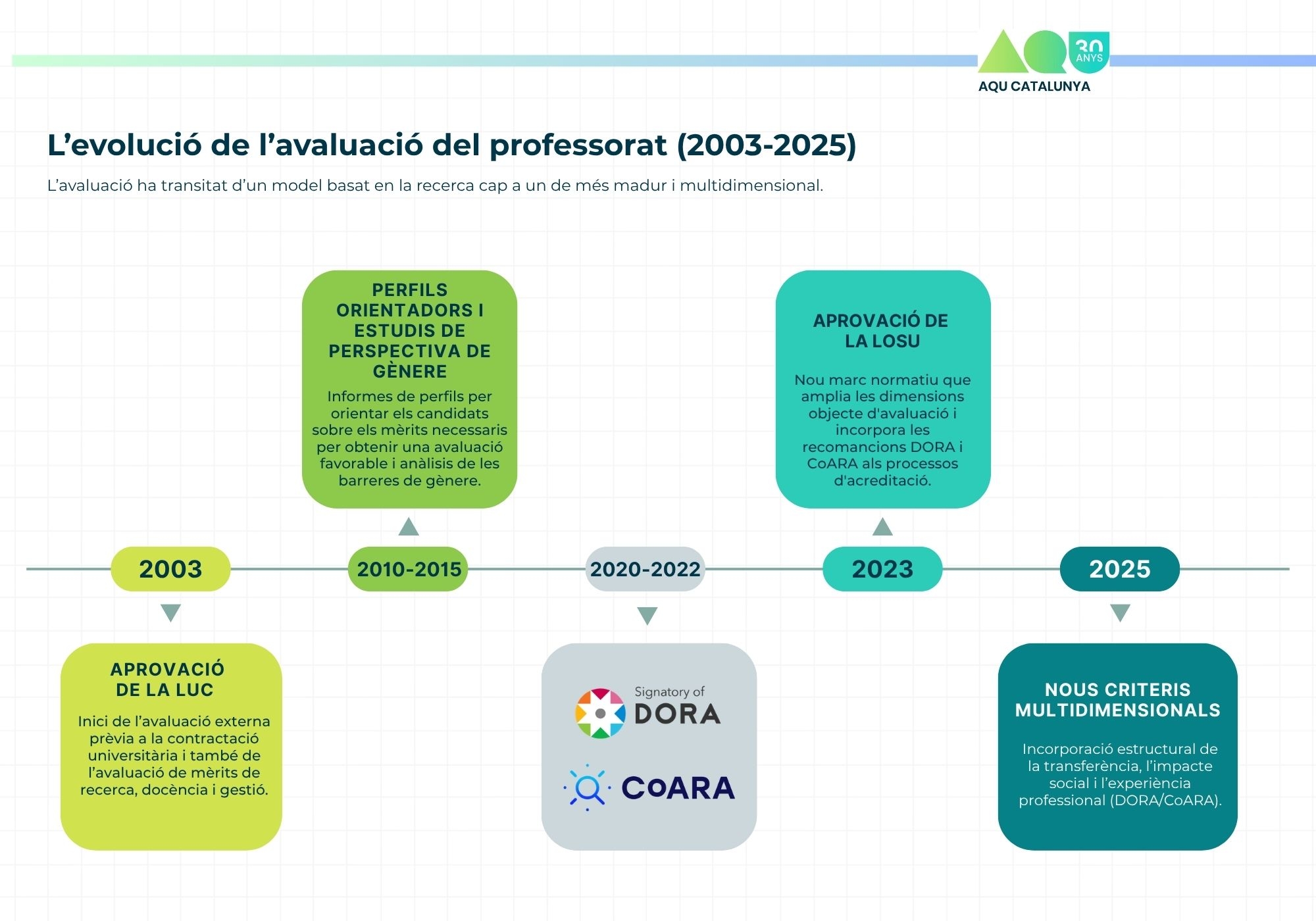
In 2003, with the approval of the Catalan Universities Act (LUC) and with the aim of promoting scientific research at all stages, Catalonia launched a systematic evaluation programme prior to university recruitment processes for contracted academic staff, marking a turning point in the academic staff model within the university system, especially regarding the incorporation of non-tenured staff into universities. In this context, AQU Catalunya’s academic staff accreditation programme was created, managed through the Research Assessment Commission (CAR) and the Commission for Assistant and Associate Lecturers (CLIC) — in place until 2015 — with the aim of ensuring that those seeking to enter a stable academic career meet minimum thresholds of quality and professional competence. This accreditation system, implemented in Catalonia and across the rest of Spain, is a distinctive feature, as it introduces an external and independent evaluation prior to university hiring and promotion processes, which is uncommon outside Spain.
Accreditation has specific characteristics that must be understood to grasp its limitations: the evaluation is based on trust between parties, it is indirect, and the committees do not assess candidates in person or systematically read all submitted original materials, but instead base their judgement on verifiable CV evidence — publications, projects, thesis supervision, teaching, stays — relying on prior peer-review processes carried out by journals, publishers and competitive funding calls. In this framework, quality prevails over quantity. This approach, distinctive in the European context, aims to reduce the risks of academic inbreeding and strengthen impartiality, consistency and credibility in university hiring processes.
In addition to accreditation, since 2003 AQU Catalunya has also assessed research, teaching and management merits of university academic staff. In the assessment of teaching and management merits, AQU Catalunya certifies that universities have applied the evaluation process in accordance with established procedures. In the case of research merits, it directly assesses the individual research merits of contracted academic and research staff based on established procedures and criteria, and recognises evaluations carried out by the National Agency for Quality Assessment and Accreditation (ANECA-CNEAI) for civil servant academic staff upon request. This assessment follows the same model as the academic staff accreditation described above.
Consolidation of the model and specialisation of committees
Over more than twenty years, academic staff evaluation has been consolidated and expanded. Regarding staff accreditation, more than 25,000 evaluations have been carried out across different categories (some now discontinued, such as associate lecturers, private university lecturers and assistant lecturers; and current categories such as associate professor and full professor). In the case of research six-year assessment periods, more than 14,000 evaluations have been conducted.
In parallel, the CAR has also developed a stable structure of discipline-specific committees — Humanities, Social Sciences, Sciences, Life Sciences, Medical and Health Sciences, and Engineering and Architecture — composed of experts with proven academic careers. These committees have been key to adapting general criteria to the real research practices of each field, while maintaining a common quality-based logic.
Guiding profiles, pedagogical function and gender perspective
One of the distinctive features of AQU Catalunya’s academic staff programme has been its pedagogical intent. From the mid-2010s onwards, the Agency promoted several profile reports of accredited staff — both assistant lecturers (2013–2017) and associate professors (2017–2019) — aimed at providing data-based guidance on the merits of successfully evaluated candidates. These reports, which increase transparency, clearly show that evaluation combines quantitative and qualitative criteria, and that quality systematically prevails over quantity. The CAR has also conducted gender-perspective analyses showing how women’s academic careers are affected by structural barriers such as care responsibilities, higher teaching loads or glass ceilings.
The change of era: the new LOSU paradigm
With the approval in 2023 of the Organic Law of the University System (LOSU), a new stage begins. Without eliminating the requirement of prior accreditation, LOSU redefines its objectives: stability, predictability of academic careers and comprehensive recognition of academic activity. In line with this framework, AQU Catalunya has redefined its accreditation criteria to structurally incorporate teaching, knowledge transfer, professional experience and societal impact, aligning with international initiatives such as DORA and CoARA.
The new criteria, applicable from 2025, include key principles: separate (and non-compensatory) evaluation of teaching and research, recognition of teaching evaluations certified by AQU, alignment of requirements with the actual duration of the early career stage, and maintaining scientific leadership as a specific dimension of the full professor role.
Teaching evaluation: a priority
Alongside academic staff accreditation activity, AQU Catalunya has continuously developed significant work in the field of university teaching evaluation. Since the early 2000s, the Agency has promoted and consolidated its own model based on certified teaching evaluation manuals, enabling Catalan universities to adopt systematic, comparable tools that respect institutional autonomy for assessing teaching activity. This programme has become a reference at both national and European level.
All this work carried out by AQU Catalunya since 2003 has also led to a modernisation process in the management of academic staff accreditation calls. This has resulted in a fully digitalised system based on a year-round open call and the development of tools that facilitate application submission and management.
From 2003 to the present, AQU Catalunya’s academic staff evaluation programme has evolved from a model focused almost exclusively on research into a mature, multidimensional system based on empirical evidence. Without renouncing the principles of impartiality, quality and expert participation that have defined it from the beginning, the programme now faces a new era that seeks to combine academic excellence with sustainability, equity and diversity of career paths.