
 Share
ShareAQU Catalunya presents the results of the REMOTE project at the INQAAHE Forum 2026
Two members of the Agency participated in this interactive presentation of the project, which was launched in 2023 as part of the European Erasmus+ initiative.
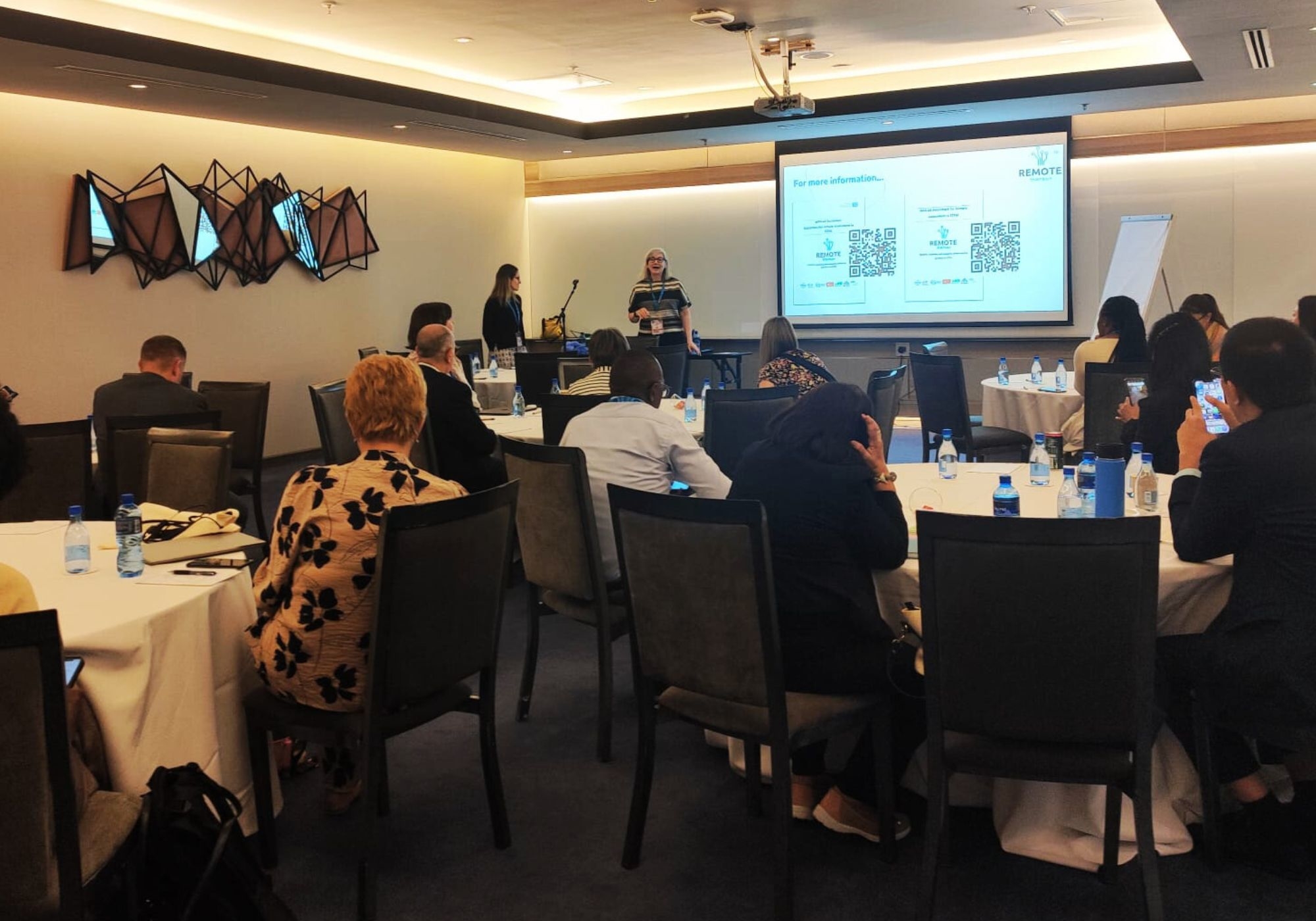
The senior advisors from AQU Catalunya’s Quality Assurance Department, Noèlia Grifo and Carme Edo, presented the results of the project Assessing and Evaluating Remote Learning Practices in STEM (REMOTE) during the INQAAHE Forum 2026, held this week in Pretoria (South Africa) by the International Network for Quality Assurance Agencies in Higher Education (INQAAHE). The presentation, entitled Strengthening trust in remote and hybrid assessment through transparency, stakeholder co-creation, and integrity-driven quality assurance frameworks, was delivered in a hybrid format and took place on 5 February.
As a result of the session, Grifo and Edo drafted a manifesto that gathers the views of the participants in this presentation, which focused on strengthening trust in remote and hybrid assessment through transparency, on joint co-creation with stakeholders, and on integrity-based quality assurance frameworks. As stated in the manifesto, representatives from higher education institutions and quality assurance agencies present believe that high-quality online assessment must be flexible, hybrid, and multifaceted. They also consider formative evaluation to be essential and that it must be aligned with learning outcomes and the curriculum, regardless of the modality in place.
The manifesto also notes that coordination and monitoring of assessment are relevant because they improve its quality. In addition, it points out that high-quality online assessment requires training and institutional support for teaching staff and that, in this regard, teaching engagement is essential. The document also concludes that interaction with teaching staff and their feedback are central to improving student learning, engagement, and motivation, and that academic integrity has to be ensured through assessment design, personalization and continuous evaluation. Finally, the text states that equity and inclusion are core indicators of quality, including access to technology: robust technological infrastructure is essential for fair and reliable assessment. It also indicates that evaluation should promote continuous improvement. During the session, despite having a diverse attendee profile, there was a high presence of university staff. You can find out more about their presentation here.
The REMOTE project, funded by the Erasmus+ programme, operates within the framework of cooperation partnerships in higher education and is aimed at analysing and improving remote learning in the university context, especially in STEM areas (Science, Technology, Engineering and Mathematics). Launched in 2023, it is led by the Universitat de Girona (UdG) and involves the participation of AQU Catalunya and five additional partners: the Universitat Internacional de Catalunya (UIC); the Politecnico di Torino (PoliTo), Italy; the Universidade do Minho (UMinho), Portugal; the Agenzia Nazionale di Valutazione del Sistema Universitario e della Ricerca (ANVUR), Italy; and the Agência de Avaliação e Acreditação do Ensino Superior (A3ES), Portugal.
In addition to the two senior advisors from AQU Catalunya, the Agency’s delegation to the INQAAHE forum in Pretoria also included the Agency’s president, Francesc Xavier Grau; the Agency’s director, Mercè Gisbert; and the Head of the Internationalisation and Knowledge Generation Area, Anna Prades, who has been a member of the governing board of the international INQAAHE network since 2021. INQAAHE is an international association that brings together more than 300 organisations working in quality assurance in higher education, most of them quality agencies. AQU Catalunya has been a member of this network since 1998 and served as its secretariat from October 2013 until 2022.