
 Share
Share30 Years of AQU Catalunya: Three Decades Generating Knowledge for University Quality
Throughout 2026, the Agency is publishing monthly articles reviewing its three decades of history from different perspectives. The May edition highlights the knowledge-generation work carried out by AQU Catalunya to provide the Catalan university system with indicators that support evidence-based decision-making.
As established by the Standards and Guidelines for Quality Assurance in the European Higher Education Area (ESG), quality assurance has a dual purpose: accountability and enhancement. Both require reliable, comparable and useful information for decision-making. If quality refers to processes and standards to the objectives to be achieved (Harvey, 2024), it is difficult to talk about quality without indicators that allow these objectives to be measured, and benchmarks that enable both longitudinal and cross-sectional assessment of relative positioning.
Knowledge generation has been part of AQU Catalunya’s mission since its inception. From the earliest evaluation reports, indicators were progressively incorporated. First through the development of the university information system (UNEIX), and later through surveys promoted by universities and cyclical surveys coordinated by AQU Catalunya. Over the past thirty years, this function has developed mainly through two major pillars: academic indicator systems and survey-based studies.
Academic indicators
The consolidation of UNEIX enabled the gradual incorporation of quantitative evidence into evaluation processes, linked to inputs (student profile), resources (faculty, service data) and academic outcomes (performance rates, success, dropout rates, etc.). Later tools such as Winddat (2012) and the EUC portal (2016) improved access to and visualization of information, contributing to greater transparency in the Catalan university system. While early evaluation processes were dominated by descriptive reports, today we have comparable indicators that allow contextualisation of results, identification of trends and evidence-based decision-making.
Other key milestones include the definition of the Teaching Indicators Catalogue (2005) and the AQU Catalunya Degree Catalogue (2016).
Survey studies
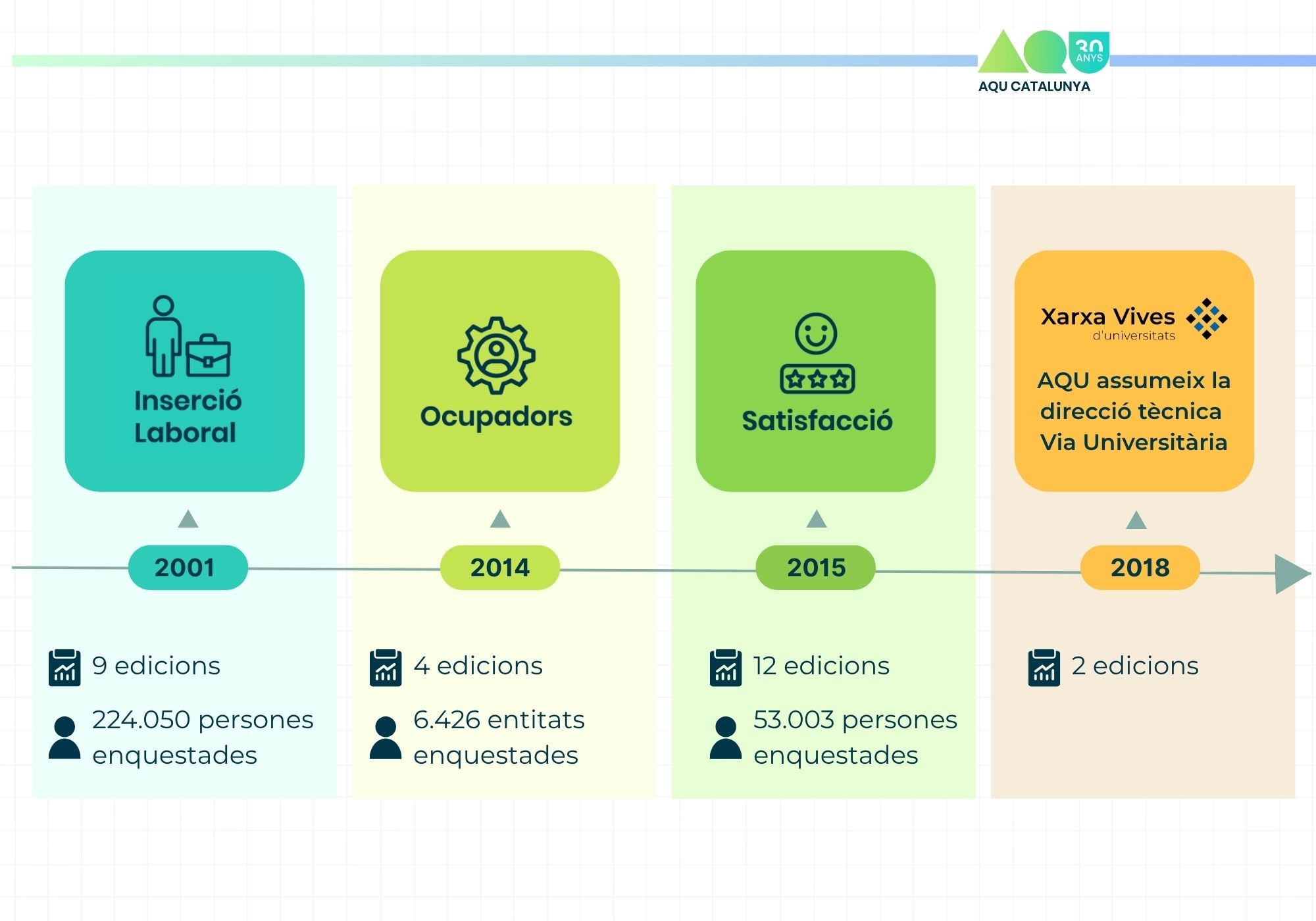
The second major pillar has been the development of university system surveys. The Graduate Employment Survey, designed in 2000 and first implemented in 2001, marks the origin of the Knowledge Generation unit. Since then, the Employer Survey (2014) and the Recent Graduates Satisfaction Survey (2015) have been added, forming a stable system for collecting information on higher education outcomes and impact.
These surveys share two key features. First, they are co-designed with universities through the system’s participatory structures. Second, they aim to provide useful information for decision-making and for improving degrees, institutions and universities.
From accountability to a culture of quality
Law 15/2015 of 21 July on the Agency for the Quality of the University System of Catalonia explicitly assigns AQU Catalunya functions related to system observation and analysis, indicator development and identification of improvement areas. Data collected over more than two decades have helped to inform public debate on higher education. At times when the value of university studies was questioned or talk of a “graduate surplus” emerged, graduate employment survey results provided solid evidence of the contribution of higher education to graduates’ professional trajectories and, in line with OECD findings (2025), show that people with higher education continue to enjoy better employment and career opportunities.
These studies, framed within the system observation and analysis functions of Law 15/2015, have deepened understanding of the Catalan higher education system. They have also enabled exploration of strategic issues, such as Gender differences in labour market integration 20 years after graduation (2021), and more recently, Equity in labour market insertion and social mobility.
Future challenges
If the last thirty years have been about building a robust system of evidence, the next thirty should focus on consolidating a culture of quality based on using that evidence for institutional transformation.
As Harvey (2024) notes, the future of quality systems requires shifting emphasis from formal compliance to institutional commitment to improvement. In this sense, quality is built not only through procedures and standards, but also through institutions’ ability to analyse available evidence, reflect on outcomes and drive meaningful change. The challenge is no longer to generate more data, but to use it better. The main goal of AQU Catalunya’s Internationalisation and Knowledge Generation unit is to work with the Catalan university system to provide useful, comparable indicators and studies oriented toward decision-making.